
Lumi Master/Basics
Lumi Master Basics
Lumi Master is Bilibili Games' cozy monster collector — you walk hand-drawn zones one screen at a time, catch creatures called Lumi with cards, battle with a squad of three, and run a home base where your Lumi work. It launched worldwide on 17 September 2026 (soft-launch progress was wiped at launch, so everyone started level). This page explains how each system actually works; for what to do with it, see the Beginner Tips guide, and for which Lumi are worth building, the tier list.
The explore loop: Energy and the Starlit Compass
Everything starts from the Explore screen. Tapping the Starlit Compass spends Energy and walks you forward; along the way you meet wild Lumi, other explorers who battle you or hand out items, treasure, and small events.
Energy regenerates on its own, but only up to a cap shown in the top bar, and that cap rises as your player level goes up. Rewards can push you above the cap — you just stop regenerating until you spend back below it. Energy is the real limiter on how much you can do in a sitting, and the game hands a lot of it out through tasks, mail, codes and events (see the Beginner Tips guide for the full list).
Each zone holds five Lumi species. Catching them fills the zone's tracker and unlocks its boss; clearing the zone opens the next chapter. The main route runs Rainforest, then Beach, Volcano, Desert and Snow Mountain, with time-limited Season zones on the side that carry Lumi you can't find on the main route.
Energy multipliers: the system that changes everything
The compass doesn't just spend one step of Energy at a time. Once you have enough banked you can raise its multiplier, and every step then spends that multiple of Energy — and returns that multiple of everything: items, coins, experience and battle rewards.
Higher multipliers also change encounters. Instead of one Lumi you meet a whole group at once and can catch them together with one round of cards. The top tier, ×1000, needs over 5,000 Energy banked plus a special buff to be active, and throws around 100 Lumi at you in waves of five.
A zone's boss is also guaranteed to appear after a set number of Lumi encounters (roughly 120), so high multipliers reach bosses far faster.
| Multiplier | Lumi per encounter |
|---|---|
| ×1 | 1 |
| ×50 | About 5 |
| ×100 | About 10 |
| ×1000 (5,000+ Energy and a special buff) | About 100, in waves of 5 |
Catching: cards, timing and candy
Catches use Lumi Cards. Before you throw, the game shows a Catch Rate; press at the right moment as the card flies and you get a bonus of up to ×1.5 on it (a 40% catch becomes 60% on a perfect throw). A failed catch breaks the card and the Lumi can escape.
Cards come in grades, and higher grades are built for higher rarities — an ordinary card might show a 3% chance on a Gold boss where a Legendary card shows 100%. You craft cards at a workshop in your home base and can buy them with gold in the market. Candy raises the Catch Rate further and is worth saving for rare targets.
Some Lumi — bosses especially — have to be beaten in battle before they can be caught. Stronger players can eventually skip that fight on weaker bosses.
One small event worth knowing: occasionally a luck stall appears where you wager gold or Energy and get back between ×1 and ×2. You can't lose on it, so it's always worth taking.
Rarity, Rainbow Lumi and Stella
Every individual Lumi rolls one of five rarities: Green, Blue, Purple, Gold and Rainbow. Rarity sets its stat ceilings, so a Gold copy of a species is genuinely stronger than a Green one.
Rainbow Lumi are the rarest. They can only be turned into Stella Lumi by catching them with a Stella Card — a card that works on Rainbow Lumi and nothing else. A Stella Lumi has part of its body recoloured and a stat edge over an ordinary copy. The recolour is random, and an item called the Prism Mirror re-rolls it as many times as you like. You start with a few Stella Cards and they are hard to come by, so don't spend them on anything but a Rainbow.
The main route has a guarantee built in: after a set number of encounters, a Rainbow Lumi is certain to appear. Rainbow footprints on the path are a sign one is just ahead.
Evolution re-rolls rarity too. When a Lumi evolves, a roulette decides its new rarity — usually it stays the same or climbs a little, with a small chance (under 1% in cases we've seen) of jumping to Rainbow.
Aptitude: the four stats, and why two identical Lumi differ
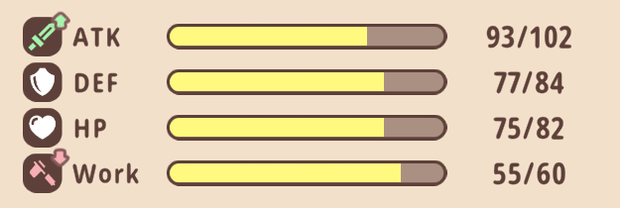
Every Lumi has four Aptitude stats — ATK, DEF, HP and Work. The first three are combat; Work is the non-combat stat, used for the home-production side of the game rather than battle.
The important detail is how they are displayed: each stat shows a current value and a second, higher number — a growth ceiling for that individual creature. A freshly caught Lumi therefore reads something like ATK 93/102, and a second one of the same species can roll a different ceiling. Two Lumi of the same species are not interchangeable, which is what makes re-catching a species worthwhile.
| Stat | What it governs |
|---|---|
| ATK | Damage dealt in battle |
| DEF | Damage reduction |
| HP | Health pool |
| Work | Speed at jobs in your home base, not battle |
Levelling, level caps and evolution
Lumi level up with materials earned mostly from exploring (a star-shaped tooth item is the main one early on; home buildings produce some later). With the materials in hand, levelling is one tap.
Levels are capped. Raising your rank lifts the cap, and pushing a Lumi past a cap needs a breakthrough item tied to its line. You get those by releasing spare copies of the species — so buying cheap duplicates at the market and releasing them is a legitimate way to push a favourite. A universal version that works for any line also exists.
Evolution unlocks at set levels and costs items; how many stages a line has varies. Remember the rarity roulette above whenever you evolve.
Dr. Luna, an explorer you meet on the path, trades eggs for Purple Lumi. What hatches is random and can be a species you already own. One trap to avoid: Lumi bought from the market are not added to your Gallery — only ones you catch or hatch yourself count toward completion.
How combat is actually scored
A Lumi's Skill tab carries a second set of numbers that are separate from Aptitude and explain how it performs moment to moment in a fight: an ATK element (its type, shown as an icon), ATK REGEN, Power, and Attack Interval.
Attack Interval is the one to read first — it is how often the Lumi acts, so a low interval with modest Power can out-damage the reverse. Skills carry their own, much higher Power value than the basic attack.
For reference, the Fire-type starter Flameow reads ATK REGEN 0.7, Power 10 and Attack Interval 1 at level 1, with its first skill at Power 50.
How a battle plays
Battles are real-time, not turn-based, even though the camera makes them look it. Your front Lumi attacks the enemy's front Lumi automatically; each hit builds Energy, and once there is enough for a skill you tap it.
You field up to three Lumi — one slot at the start, the second and third unlocking at Exploration Lv.5 and Lv.8 — and can swap between them mid-fight. Your collection box holds 1,000 Lumi, so keep duplicates rather than releasing them without a reason. A swap has a cooldown of around 15 seconds, and a Lumi that is Dreaming can't be swapped out at all.
There is also a shield gauge. When it fills, you can raise a shield that cancels one enemy skill hit completely. Opponents use it too — spending a cheap skill first to pop an enemy shield saves your expensive one.
Type matchups matter (see the Type Chart guide), and a Lumi's Trait often decides a fight on its own — for example Psykat's Trait heals whichever squad member drops below half HP and puts the enemy into Dreaming, which also locks it on the field.
Once a fight is clearly winnable, Quick Battle skips it and just gives you the result.
Traits and skills unlock as a Lumi levels
A Lumi does not arrive with its kit complete. Its Trait — a passive that shapes how the rest of the kit plays — is gated behind Lumi Lv.10, and its second skill behind Lumi Lv.20, both stated plainly on the card with the requirement showing while locked.
The first skill is the Lumi's signature and fixed. The second can be swapped for another from the Lumi's pool by spending coins, so the same species can be set up for different jobs.
Flameow is a clean example of how the pieces interlock. Its skill Spark singes the target with a 50% chance to apply one stack of Burn; its Lv.10 Trait, Hasty Flames, then grants a stack of Swift whenever it applies Burn. The Trait is what turns the skill's status effect into a tempo gain, and until Lv.10 that half of the design simply is not there.
Types: 17 of them, with an in-game counter chart
Lumi Master runs 17 types: Normal, Water, Fire, Grass, Electric, Ground, Flying, Ice, Dragon, Light, Dark, Brawler, Psychic, Fairy, Steel, Royal and Divine. It is a Pokémon-shaped list with three additions of its own — Brawler, Royal and Divine. Many Lumi carry two types.
The game ships its own type-counter chart in-game, so matchups matter rather than being cosmetic. Our full type chart — every super-effective and resisted matchup across 16 of the 17 types (Divine sits outside the counter system entirely) — is transcribed directly from that in-game chart; see the Type Chart guide.
Game modes
Beyond exploring, battles come in several modes, most of them unlocked by player level as you go. All of them pay out coins and materials — win or lose, you still earn something.
| Mode | What it is |
|---|---|
| Main story and Gym battles | Set fights with story dialogue, in tiers of difficulty; Quick Battle works once you outclass them |
| Gauntlet | A win-streak ladder of ever-stronger trainers, well over 100 rounds deep; unlocks around player level 30 |
| Trial Hall | Fights against elite explorers on Easy, Hard and Hell difficulty |
| Tower | Climb floor by floor as your squad gets stronger |
| Ladder | Ranked matchmaking against other players' squads |
| Weekly tournament | Rank-based event with rewards by placement |
| Aid | Lend your Lumi for other players to use, with gold coming back to you |
Home base: work, prosperity and upkeep
Your home base is where Lumi work. Buildings produce wood, food, cards and other materials, and each has a Lumi assigned to it. A Lumi's Work stat sets how fast it works, and a Lumi whose job matches the building gets a bonus on top.
For the first days of a new account a Starter Blessing doubles production speed and building storage, which makes setting up good workers early much more valuable than it looks.
Upgrading the central statue is how the base grows, and it is gated by Prosperity, which you raise by placing decorations and facilities. Working Lumi also get hungry: feed them, or build the serving station that feeds all of them at once. Later, a Manage screen can auto-plan production. Speed-up items are scarce, so save them.
The same hub leads to the player market (buy and sell Lumi and items for gold), guilds, and the Starlit Tree, which trades Lumi you don't need for Energy.
Every Lumi has a personality profile
Alongside stats, each Lumi carries a Profile tab: an editable name, a personality with a re-roll control beside it, a height in centimetres, a gender, a mood, a Badge section, and a Bio line that records where and when you met it.
Most of this is flavour rather than power.
How big is the roster?
The game files hold several hundred Lumi: the client's animation data covers 399 distinct Lumi codenames — species plus their alternate forms — backed by 653 separate Lumi art bundles. Families appear with baby and grown forms side by side, and some species carry three or more variants.
Two collaboration creatures are already present in the client as well: Rathalos, the Monster Hunter wyvern, and a nine-tailed fox spirit appearing in several forms.
Our Lumi list currently catalogues 193 of them, taken from the game's own data tables. The rest of the roster (including the two collaborations above) isn't catalogued yet rather than guessed at; it fills in as coverage grows.
loadoutgg is not affiliated with, endorsed by, or sponsored by Bilibili Games or the creators of Lumi Master. Lumi Master and all Lumi names, art, and other assets referenced here are trademarks and copyrighted material of their respective owners, used for informational/fan-reference purposes. The classification, skill and ability text, and other compiled game data on these pages are loadoutgg's own work — extracted from the game's own files and official sources and rewritten in our own words. This compilation is not offered for reuse; please link to loadoutgg rather than copying or scraping it. The Chinese-version BWIKI (wiki.biligame.com/lumi) was used as a cross-reference for factual in-game data only; no text or artwork from it is reproduced. Full copyright & licensing detail is at loadoutgg.com/legal.