
Lumi Master opens by walking you into the Rainforest and offering a choice of three Lumi. This guide covers what that choice looks like, what it does and does not lock you out of, and — using the Fire starter Flameow — exactly what a Lumi's numbers mean when you are staring at your first card.
The choice: three Lumi hiding in the Rainforest

There is no login screen or account setup first — the game drops you straight into the Rainforest, where brushing aside the foliage reveals three Lumi and a prompt to "be friends with one of them". Tapping through gives you a name-and-type card for whichever you highlight, and confirming catches it at a scripted 100% Catch Rate.
The trio covers the classic three types: Flameow, a red Fire-type cat with a flame crest; Jellibae, a blue Water-type jellyfish with a pink cap; and a green Grass-type Lumi perched on a leaf.
The important reassurance: this is a catching game with a 1,000-slot collection box, not a one-shot commitment. Your starter is your first Lumi, not your only one — the other two species can still turn up later, including from the eggs Dr. Luna trades for Purple Lumi.
Which starter should you pick?
Pick the one you like the look of — the gap between them is small, and none of them is a long-term carry on its own.
On our tier list, Flameow and Jellibae both sit at B in their base forms. Where they differ is the ceiling: Jellibae evolves into Jellibow and then Jellistel, which picks up a second type (Water / Fairy) and climbs to A. If you want the starter with the most payoff for levelling, Jellibae is the pick.
Two things matter more than the choice itself. First, rarity: every individual rolls Green through Rainbow, so a Gold copy of any starter beats a Green one, and evolving re-rolls that rarity. Second, type coverage: with 17 types and a real counter chart, a squad of three different types serves you better than three copies of your favourite. The Type Chart guide lists every matchup.
Grass beats Water and Water beats Fire in the usual way, so whichever you pick, the other two are the first gaps to fill.
Reading your first card: Flameow in full
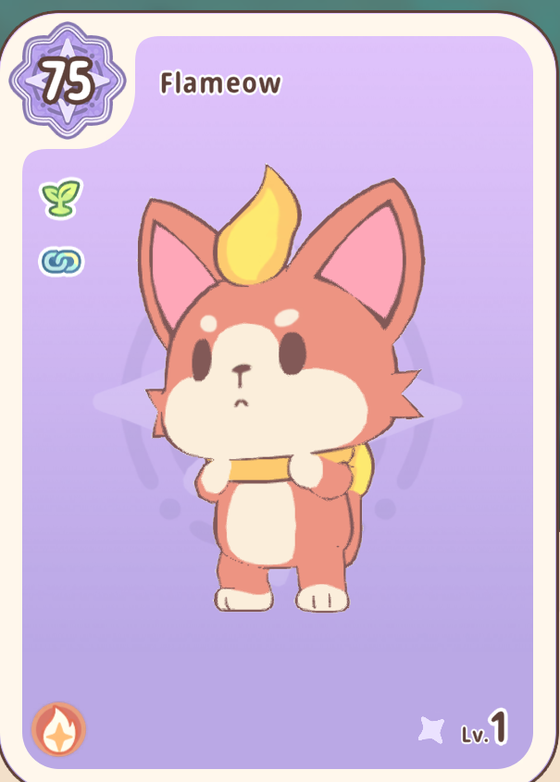
Flameow is the Fire-type starter, and its card is a good tour of what every Lumi card shows. At level 1, freshly caught, it reads as below.
The Aptitude numbers are the ones people misread first. Each shows a current value and a ceiling — 93/102 ATK means 93 now, capped at 102 for this particular Flameow. Another Flameow rolls its own ceilings, so those second numbers are the individual quality of the creature you caught, not a shared species stat.
Note also what is missing at level 1: its Trait is locked until Lumi Lv.10 and its second skill until Lv.20. Half of Flameow's design is not visible on the card you are handed.
| Field | Value at Lv.1 |
|---|---|
| Type | Fire |
| Card number | 75 |
| ATK | 93 / 102 (ceiling) |
| DEF | 77 / 84 |
| HP | 75 / 82 |
| Work | 55 / 60 |
| ATK Regen | 0.7 |
| Power (basic attack) | 10 |
| Attack Interval | 1 |
| Skill — Spark | Power 50. Singes the target, 50% chance to apply 1 stack of Burn. |
| Trait — Hasty Flames | Locked until Lumi Lv.10. Applying Burn grants 1 stack of Swift. |
| Second skill | Locked until Lumi Lv.20 |
| Height | 70 cm |
| Personality | Playful (has a re-roll control) |
Why Flameow gets better at Lv.10, not gradually
Flameow's two halves are designed to click together, and they only do so at Lv.10.
Spark applies Burn about half the time. Hasty Flames, the Lv.10 Trait, converts every Burn application into a stack of Swift on Flameow itself. Before Lv.10 you have a chance-based damage-over-time effect; after Lv.10 the same skill also compounds your own tempo.
The general lesson for the whole roster: judge a Lumi at Lv.10, not at capture. The Trait line is where a species' identity lives, and the card hides it until then.
What the opening hour asks of you
After the starter, the early game is a short chain of small objectives that walk you through the catch loop: tap the compass to explore, catch the five Lumi in the Rainforest, beat and catch its boss, and the Beach opens as Chapter 2.
Your first real wall is usually that boss. It often out-damages an unlevelled starter badly, and the fix is simply to spend the levelling materials you have picked up on the way — a few levels and a well-timed shield turn the fight around. Bosses tend to be Gold, so when the catch screen shows a single-digit chance, switch to a higher-grade card rather than burning ordinary ones.
Early on, set your first Lumi to work in the home base as soon as it opens; a new account's Starter Blessing doubles production for the first days, so early workers pay back more than they ever will again.
Your second and third squad slots arrive at Exploration Lv.5 and Lv.8, which makes early Exploration levels the thing actually worth pushing — a second and third Lumi in the squad is a far bigger power gain than any single catch. For what to do once the tutorial ends, see the Beginner Tips guide.